Adaptive practice: how a practice level works
In Reppilo a pupil in a class practises at their own practice level. They move up by themselves when they get the questions right and fluently, and one level back when it goes wrong too often. The teacher sees in one grid who is where.
What the pupil does, and what the teacher sees
A pupil signs in with the code of their class and practises times tables, sums, telling the time or verbs. They get a round at their own practice level, with a bar that shows how far they have come. The pupil sees no arithmetic about themselves: only where they stand and what the next small step is.
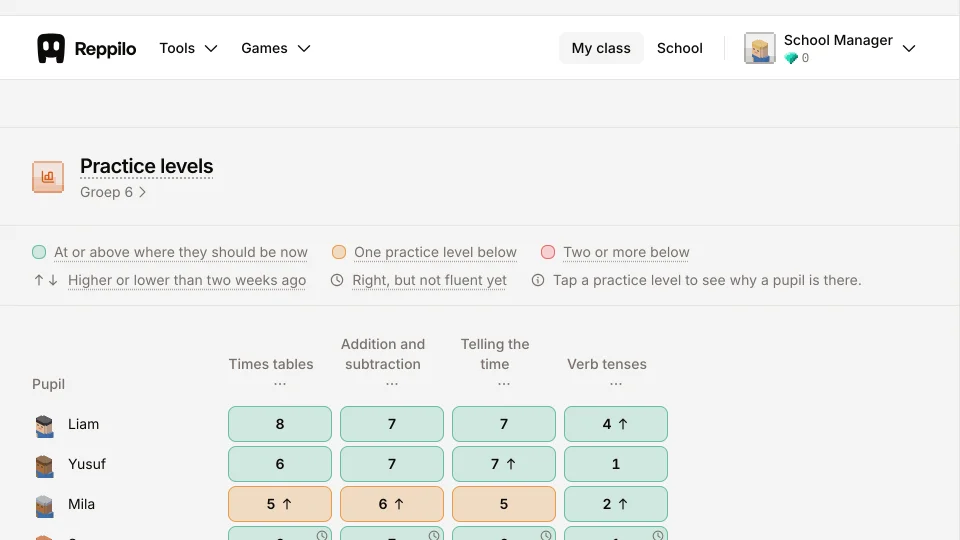
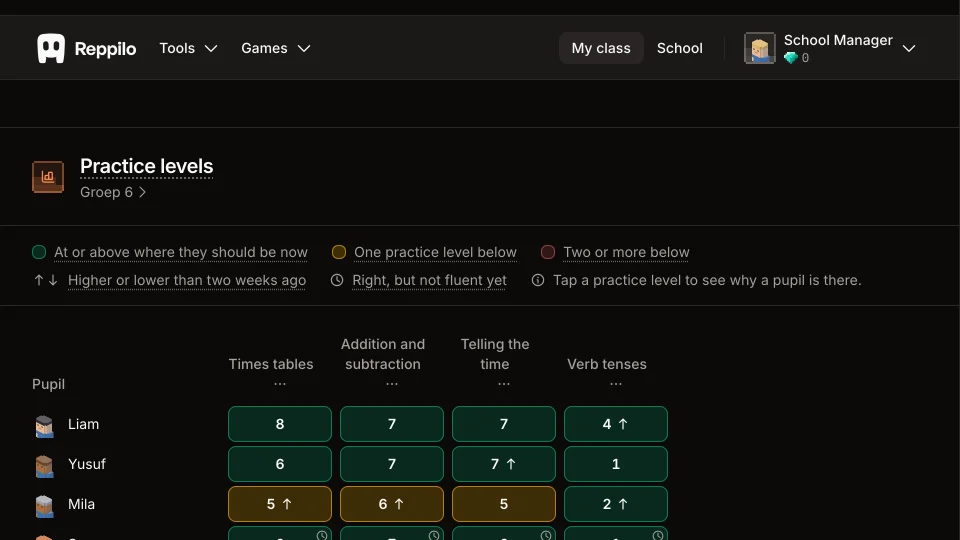
In the class grid the teacher sees the practice level of every pupil for every skill. The colour says how that compares with what the class should be able to do now. A small clock stands next to a pupil who gets the questions right but not fluently yet: that pupil needs speed, not a new explanation.
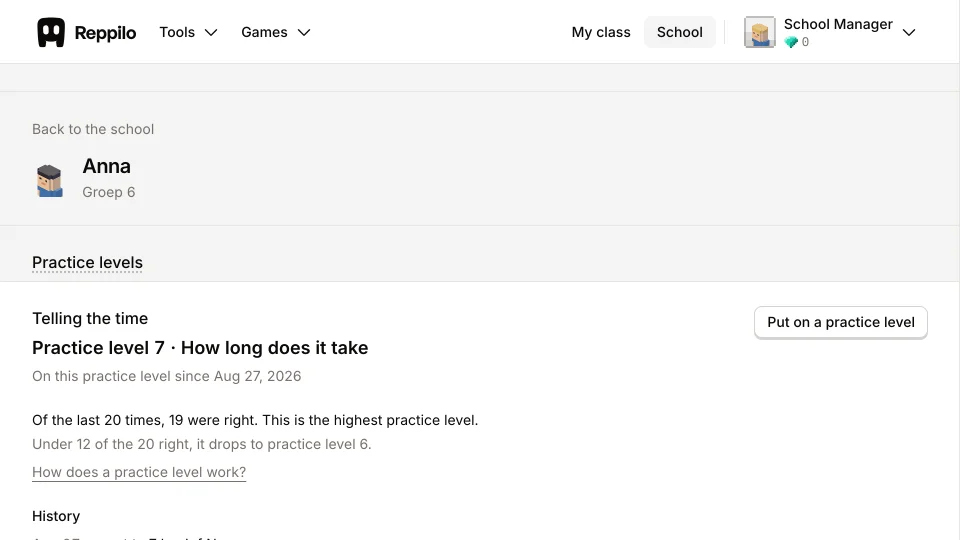
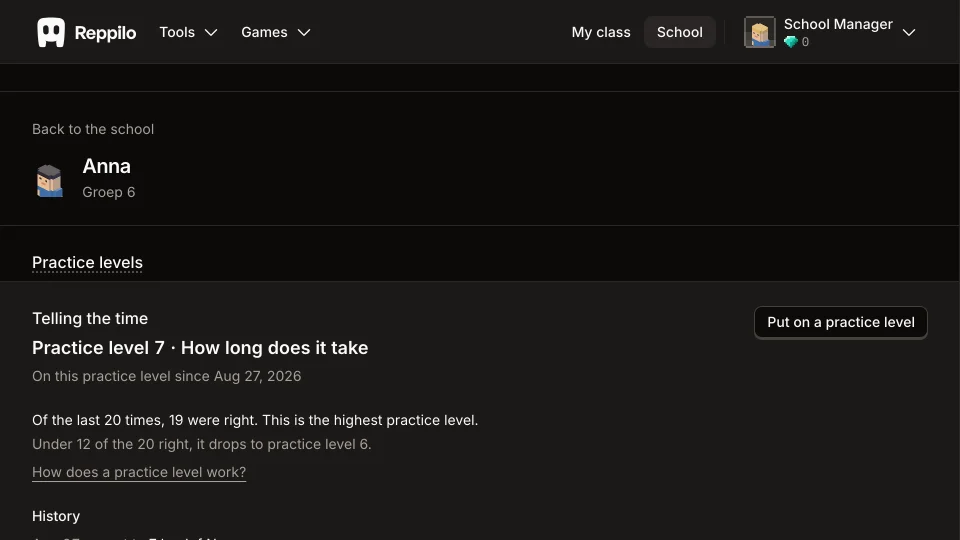
Tap a pupil and you see why they stand there: how many of their last answers were right, what they need to move up, and when they moved up or down.
The rule
The same rule holds for every skill and every pupil. Only the time norm differs per practice level. You find it in the tables below.
- Up: of the last 20 answers on a practice level, 18 are right, and the pupil answers faster on average than the time norm of that practice level.
- Down: when fewer than 12 of the last 20 answers are right, the pupil practises one practice level lower. Never after one bad round.
- A pupil who is new may move up the first time after 10 answers already, with 9 right. That way they quickly get to the right place.
- Every round also repeats what lies below: at most 25 percent of the questions come from a lower practice level, and they count as usual.
- When a pupil chooses what to practise, the practice level stays where it is. What they got wrong there does come back more often in their next rounds.
The practice levels per skill
Each practice level is named after what the pupil practises on it. Each one shows when an answer is fluent, whether a certificate comes with it, and at the end of which school year the curriculum expects it. Choose the country of your school.
A certificate comes when a pupil moves up by themselves from the practice level with the certificate. Not when they arrive there, and not when a teacher puts them above it.
Times tables
| Practice level | What the pupil practises | Fluent is faster than | Expected at the end of |
|---|---|---|---|
| 1 | 1, 2 and 10 times tables | 5 seconds | Year 2 |
| 2 | 3 and 5 times tables | 5 seconds | Year 2 |
| 3 | 4 times tableCertificate | 5 seconds | Year 3 |
| 4 | 6 and 9 times tables | 5 seconds | Year 3 |
| 5 | 7 and 8 times tables | 5 seconds | Year 3 |
| 6 | 11 and 12 times tables | 5 seconds | Year 4 |
| 7 | All tables mixed upCertificate | 5 seconds | Year 4 |
| 8 | Division tablesCertificate | 5 seconds | |
| 9 | Times and divide with zeros | 6 seconds |
Addition and subtraction
| Practice level | What the pupil practises | Fluent is faster than | Expected at the end of |
|---|---|---|---|
| 1 | Splitting numbers | 4 seconds | |
| 2 | Up to ten | 4 seconds | |
| 3 | Jumping to a hundred | 5 seconds | |
| 4 | Crossing ten | 5 seconds | |
| 5 | Up to a hundred | 5 seconds | |
| 6 | Crossing a ten | 5 seconds | |
| 7 | Up to a thousand | 6 seconds |
For this skill the curriculum of this country expects nothing per school year yet.
Telling the time
| Practice level | What the pupil practises | Fluent is faster than | Expected at the end of |
|---|---|---|---|
| 1 | Whole hours | 6 seconds | |
| 2 | Half hours | 6 seconds | |
| 3 | Quarter hoursCertificate | 8 seconds | |
| 4 | Five minutes | 8 seconds | |
| 5 | To the minute | 10 seconds | |
| 6 | Digital tooCertificate | 10 seconds | |
| 7 | How long does it take | 20 seconds |
For this skill the curriculum of this country expects nothing per school year yet.
Verb tenses
| Practice level | What the pupil practises | Fluent is faster than | Expected at the end of |
|---|---|---|---|
| 1 | I work, you work, he works | 10 seconds | |
| 2 | He works: with -s | 12 seconds | |
| 3 | Past tense: worked | 15 seconds | |
| 4 | Irregular past: ran, went | 15 seconds | |
| 5 | Perfect: has worked | 15 seconds | |
| 6 | All mixed up | 15 seconds |
For this skill the curriculum of this country expects nothing per school year yet.
Ways to play: what works where, and what counts
You use a tool on your own or together. On your own has three forms, because what counts depends on who signs in. Together, the class plays a game against each other, and in connect four a pupil challenges a classmate.
What works where
Every tool works on your own, also without an account. These are the tools that can do more.
| Tool | At a practice level | Together | Challenge a classmate |
|---|---|---|---|
| Verb tenses | |||
| Times table practice | |||
| Mental maths practice | |||
| Telling the time | |||
| Connect four | |||
| Typing race |
What counts for what
| Way to play | Points | Practice level | What the pupil practises next | Grid per question |
|---|---|---|---|---|
| On your own, without signing in | No | No | No | No |
| On your own, your own choice | Yes | No | Yes, if Reppilo handed out the round | Yes, if Reppilo handed out the round |
| On your own, at your practice level | Yes | Yes | Yes | Yes |
| Together | Yes | No | Yes, on a tool with practice levels | Yes, marked as a class game |
| Challenge a classmate | Yes | No | No | No |
- Whoever answers earns points, pupil or teacher. Whoever only watches earns nothing.
- What the pupil practises next: a question they got wrong last time comes back more often in the next round.
- A game together does not count for the practice level. The teacher chooses what is played, and everybody gets the same, or it would not be a fair race.
What a practice level is not
A practice level is not a test and not a test score. It says where a pupil practises now, not what they can do on one fixed day. It does not go into the pupil records of the school either.
A teacher can put one pupil or the whole class on another practice level. The pupil starts counting again there and gets no certificate for it. After that, the rule takes over again.
What happens to the data
For every answer Reppilo keeps the question, whether it was right and how long the child took. The practice level comes from that. After a year those answers are deleted, so a child does not carry its old mistakes around for years. The practice level itself stays.
Frequently asked questions
Does a pupil need an account?
A pupil practises at their practice level when they sign in with the code of their class. Anybody can use the tools without signing in, but then there is no practice level and Reppilo keeps nothing.
Where does a new pupil start?
A new pupil starts on what the previous school year expects at its end, in the country of the school. Without a school year they start at the bottom. The first time they may move up sooner, so they quickly get to the right place.
Why does a pupil with almost everything right not move up?
Because they also have to be fluent. A pupil who gets the questions right but slowly knows them, but not by heart yet. Then practice at speed helps, not a new explanation. The teacher sees this as a small clock in the class grid.
Can a teacher set the practice level?
Yes, for one pupil or for the whole class. The pupil starts counting again there and gets no points or certificate for it. After that they move up or down by themselves again.
Does playing together count for the practice level?
No. In a game together the teacher chooses what is played, and everybody gets the same. What a pupil got wrong there does come back more often in their own rounds.
Does it cost anything?
Practising costs a pupil nothing. The insight for the teacher, such as the class grid and why a pupil stands where they stand, comes with the school licence.